
Interviewing is a broad subject, and the right book depends on what kind of interview you mean. A hiring manager, a journalist, a counselor, and a law enforcement professional all need different techniques, different question structures, and different ways to handle pressure. The strongest books on interviewing reflect those differences instead of treating every interview as the same exercise.
If you are trying to improve how you ask questions, listen, and steer a conversation, the best place to start is with books that are practical, respected, and specific about their audience. The list below focuses on titles that solve real interviewing problems rather than offering vague advice about communication.
Quick Answer
If you want the clearest entry point into interviewing, start with Asking the Best Questions: A comprehensive interviewing handbook for journalists, podcasters, bloggers, vloggers, influencers, and anyone who asks questions under pressure. It gives you a useful foundation in question design, listening, rapport, evidence, and the ethical limits of extracting information. Choose Knock ’em Dead Job Interview: How to Turn Job Interviews Into Job Offers (Knock ’em Dead Career Book Series) when you want a more applied or contrasting approach, and use Motivational Interviewing: Helping People Change and Grow (Applications of Motivational Interviewing Series) when you want to extend the idea into a different context.
This list is designed for job candidates, journalists, counselors, researchers, and hiring professionals. The recommendations are intentionally varied: some explain the underlying research, some offer exercises, and some are strongest as narrative or leadership case studies. That variety makes it easier to choose a book that matches your current question rather than buying the longest list.
Comparison Table
| Book | Best For | Why It Stands Out |
|---|---|---|
| Asking the Best Questions: A comprehensive interviewing handbook for journalists, podcasters, bloggers, vloggers, influencers, and anyone who asks questions under pressure | Journalists, podcasters, bloggers, creators, and professionals who interview people regularly. | Among the best books for interviewing, this is one of the most broadly useful because it is not tied to a single profession like counseling or law enforcement. It gives readers a practical framework for preparing questions, listening… |
| Knock ’em Dead Job Interview: How to Turn Job Interviews Into Job Offers (Knock ’em Dead Career Book Series) | Job seekers, career changers, and anyone preparing for interviews in a hiring process. | For readers who mean interviewing in the hiring sense, this is the most directly useful book on the list. It is less concerned with theory than with what actually helps a candidate prepare, answer with confidence, and move a conversation… |
| Motivational Interviewing: Helping People Change and Grow (Applications of Motivational Interviewing Series) | Counselors, coaches, clinicians, and other professionals who use interviewing to support change. | Compared with more general interviewing books, this one gives readers a specific framework for conversations where the goal is not information gathering alone but change itself. That makes it especially useful for counselors, coaches,… |
| Motivational Interviewing: Preparing People for Change, 2nd Edition | Practitioners, graduate students, and readers who want a serious grounding in motivational interviewing. | If the previous title is the practical entry point, this book is the more established reference. It gives readers a fuller sense of how motivational interviewing developed and how practitioners can use it thoughtfully. For anyone who… |
| Mastering Cognitive Interviewing: A Comprehensive Guide for Modern Law Enforcement. | Law enforcement professionals, investigators, and readers studying cognitive interviewing techniques. | Very few interviewing books serve law enforcement well without drifting into overly broad advice. This one does the opposite. It concentrates on a method that is directly relevant to investigative work, making it the strongest choice here… |
| Motivational Interviewing for School Counselors | School counselors, student support staff, and educators who need interviewing skills in a school context. | Many books on interviewing stop at the theory or assume a healthcare setting. This one translates the method into the realities of school counseling, which gives it a very clear purpose. It is especially useful for professionals who need… |
| The Addiction Recovery Skills Workbook: Changing Addictive Behaviors Using CBT, Mindfulness, and Motivational Interviewing Techniques (New Harbinger Self-help Workbooks) | Clinicians, recovery specialists, and readers working on behavior change support. | The book is useful for readers who want interviewing to be part of a broader recovery-support framework. Rather than focusing only on theory, it brings the method into a structured self-help or clinical context. That makes it a strong… |
How We Chose These Recommendations
These books were selected for practical value, long-term usefulness, and clear relevance to different kinds of interviewing. Some are broad and teach transferable skills, while others are specialized and better suited to a particular profession or setting. That mix matters, because interviewing is not one skill in isolation. It changes depending on whether you are trying to hire, report, counsel, investigate, or support change.
Rather than overloading the list with similar titles, the goal here is to give readers meaningful options. Each book earns its place by offering a distinct approach, a credible reputation in its field, and a format that helps a specific reader do better work.
Recommended Books
Asking the Best Questions: A comprehensive interviewing handbook for journalists, podcasters, bloggers, vloggers, influencers, and anyone who asks questions under pressure

Overview: This handbook focuses on the craft of asking good questions when the stakes are real and the conversation has to stay moving. It is aimed at people who interview others for content, reporting, or public-facing work, and it treats interviewing as a skill that can be studied and improved rather than a talent you either have or do not have.
Why it stands out: Among the best books for interviewing, this is one of the most broadly useful because it is not tied to a single profession like counseling or law enforcement. It gives readers a practical framework for preparing questions, listening well, and adapting when the interview shifts in an unexpected direction. That makes it especially valuable for journalists and creators who need to sound informed without sounding scripted.
Strengths:
- Useful across several interview formats
- Centers the skill of question design, not just conversation tactics
- Helpful for interviews conducted live or under time pressure
Best for: Journalists, podcasters, bloggers, creators, and professionals who interview people regularly.
Potential limitations: Readers looking specifically for job interview coaching or clinical interviewing methods will need a more targeted title.
View price, available formats, and reader reviews.
Knock ’em Dead Job Interview: How to Turn Job Interviews Into Job Offers (Knock ’em Dead Career Book Series)
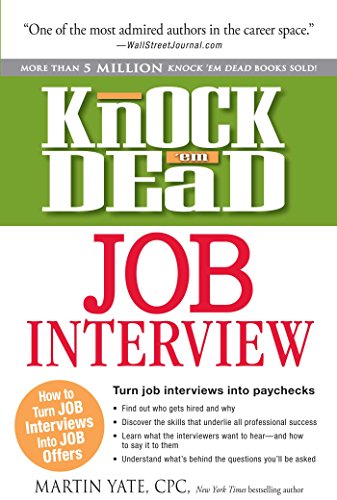
Overview: This is a job search book built around one goal, helping readers perform better in employment interviews. It covers preparation, answering common questions, presenting experience clearly, and avoiding the mistakes that can weaken an otherwise solid candidacy. The tone is practical and focused on results.
Why it stands out: For readers who mean interviewing in the hiring sense, this is the most directly useful book on the list. It is less concerned with theory than with what actually helps a candidate prepare, answer with confidence, and move a conversation toward an offer. That directness makes it a strong choice for people who want actionable guidance rather than broad career advice.
Strengths:
- Focused specifically on job interviews
- Emphasizes preparation and performance
- Accessible for readers who want concrete tactics
Best for: Job seekers, career changers, and anyone preparing for interviews in a hiring process.
Potential limitations: It is intentionally narrow in scope, so it will not help much if you need interviewing guidance for journalism, counseling, or research.
View price, available formats, and reader reviews.
Motivational Interviewing: Helping People Change and Grow (Applications of Motivational Interviewing Series)

Overview: This book explains motivational interviewing as a way of guiding conversations that help people move toward change. It is especially relevant for helping professionals who need to support behavior change without becoming pushy or adversarial. The focus is on the communication style, the spirit of the method, and how it works in practice.
Why it stands out: Compared with more general interviewing books, this one gives readers a specific framework for conversations where the goal is not information gathering alone but change itself. That makes it especially useful for counselors, coaches, therapists, and healthcare professionals. It belongs on a list of the best books for interviewing because it shows how interviews can be structured to reduce resistance and increase collaboration.
Strengths:
- Clear connection between interviewing and behavior change
- Strong fit for helping professions
- Offers a method rather than just general advice
Best for: Counselors, coaches, clinicians, and other professionals who use interviewing to support change.
Potential limitations: Readers looking for a general-purpose interviewing handbook may find it too specialized.
View price, available formats, and reader reviews.
Motivational Interviewing: Preparing People for Change, 2nd Edition

Overview: This is a foundational text on motivational interviewing, offering a deeper look at the method and the reasoning behind it. It is more detailed and more formal than shorter introductions, which makes it useful for readers who want a fuller understanding of the approach as a professional tool.
Why it stands out: If the previous title is the practical entry point, this book is the more established reference. It gives readers a fuller sense of how motivational interviewing developed and how practitioners can use it thoughtfully. For anyone who expects to use this approach regularly, the depth here is a real advantage.
Strengths:
- Foundational and widely respected in its field
- Provides more depth than a brief introductory book
- Useful as a reference for ongoing practice
Best for: Practitioners, graduate students, and readers who want a serious grounding in motivational interviewing.
Potential limitations: It is more academic than some readers need, and its depth may be more than a casual reader wants.
View price, available formats, and reader reviews.
Mastering Cognitive Interviewing: A Comprehensive Guide for Modern Law Enforcement.

Overview: This book is aimed squarely at investigative interviewing in law enforcement. Its focus is on cognitive interviewing, a technique that helps interviewers improve recall and gather better information from witnesses and subjects. The value of the book lies in its specificity, since this is not a general communication guide but a professional manual for a specialized setting.
Why it stands out: Very few interviewing books serve law enforcement well without drifting into overly broad advice. This one does the opposite. It concentrates on a method that is directly relevant to investigative work, making it the strongest choice here for readers who need a professional, field-specific resource. If your interviewing needs involve memory, testimony, and structured questioning, this is the most targeted recommendation on the list.
Strengths:
- Highly specialized for investigative use
- Centers memory and recall, not generic conversation skills
- Relevant for modern law enforcement training
Best for: Law enforcement professionals, investigators, and readers studying cognitive interviewing techniques.
Potential limitations: Its narrow scope makes it a poor fit for readers who want broader interview skills or career interview preparation.
View price, available formats, and reader reviews.
Motivational Interviewing for School Counselors

Overview: This book adapts motivational interviewing for the school environment. It is built for counselors who work with students and need a practical way to encourage reflection, cooperation, and behavior change in a setting shaped by educational relationships rather than clinical ones.
Why it stands out: Many books on interviewing stop at the theory or assume a healthcare setting. This one translates the method into the realities of school counseling, which gives it a very clear purpose. It is especially useful for professionals who need a structured, respectful way to guide conversations with students without turning every discussion into a lecture or disciplinary exchange.
Strengths:
- Tailored to the school counseling setting
- Applies a proven method in a practical context
- Useful for student support and behavior conversations
Best for: School counselors, student support staff, and educators who need interviewing skills in a school context.
Potential limitations: Readers outside education may find the examples and applications too specific.
View price, available formats, and reader reviews.
The Addiction Recovery Skills Workbook: Changing Addictive Behaviors Using CBT, Mindfulness, and Motivational Interviewing Techniques (New Harbinger Self-help Workbooks)

Overview: This workbook combines cognitive behavioral tools, mindfulness, and motivational interviewing techniques in the context of addiction recovery. Although it is more of a guided skills resource than a pure interviewing manual, it still has a clear place on this list because it shows how interviewing methods support difficult behavior-change conversations.
Why it stands out: The book is useful for readers who want interviewing to be part of a broader recovery-support framework. Rather than focusing only on theory, it brings the method into a structured self-help or clinical context. That makes it a strong companion title for therapists, recovery coaches, and readers who need practical language for supporting change in sensitive situations.
Strengths:
- Integrates interviewing with other evidence-based approaches
- Useful in recovery-focused settings
- Practical and application oriented
Best for: Clinicians, recovery specialists, and readers working on behavior change support.
Potential limitations: Because it is a workbook, it is more application-focused than a general-purpose interviewing book.
View price, available formats, and reader reviews.
Who This List Is Best For
These recommendations are a good fit for job candidates, journalists, counselors, researchers, and hiring professionals. They are especially useful if you want to understand interviewing with more nuance than a short checklist, quote, or social-media summary can provide.
- Readers who want a clear conceptual foundation before choosing a technique.
- People who prefer to compare research, practical exercises, and real-world examples.
- Professionals, students, or caregivers who need language they can apply in a real conversation or decision.
Use the Best For and Why It Stands Out columns together. A book can be excellent yet still be the wrong starting point if its depth, tone, or intended reader does not match your goal.
Final Thoughts
The strongest choice for interviewing depends on what you need to do next. Begin with Asking the Best Questions: A comprehensive interviewing handbook for journalists, podcasters, bloggers, vloggers, influencers, and anyone who asks questions under pressure if you need a foundation, move to Knock ’em Dead Job Interview: How to Turn Job Interviews Into Job Offers (Knock ’em Dead Career Book Series) if you need a practical change, and consider Motivational Interviewing: Helping People Change and Grow (Applications of Motivational Interviewing Series) if you need a broader or more challenging perspective. The comparison table is meant to shorten that decision, not pretend that one book works for every reader.
A useful reading plan is simple: select one book, write down the question you want it to answer, and apply one idea before moving to another recommendation. For this topic, prepare fewer, better questions and decide in advance what evidence would change your judgment. the right interviewing book depends heavily on whether the goal is hiring, reporting, counseling, or research.
FAQ
Which book should I read first for interviewing?
Start with Asking the Best Questions: A comprehensive interviewing handbook for journalists, podcasters, bloggers, vloggers, influencers, and anyone who asks questions under pressure if you want the clearest foundation. If your immediate need is action rather than background, compare it with Knock ’em Dead Job Interview: How to Turn Job Interviews Into Job Offers (Knock ’em Dead Career Book Series) and choose the one whose exercises, examples, or audience match your situation.
How do I choose between a research-based book and a workbook?
Choose the research-oriented option when you need context and a better mental model. Choose the workbook or practical guide when you already understand the problem and need repetition, prompts, or a structured plan. The table’s Best For column is the fastest way to make that distinction.
What is a practical way to use books about interviewing?
Do not read the whole list at once. Pick one recommendation, define the behavior or decision you want to improve, and test a small idea from the book for seven days. For this topic, prepare fewer, better questions and decide in advance what evidence would change your judgment.
Are these recommendations suitable for self-study?
Yes, for education and structured reflection. Take notes in your own words, mark claims you want to verify, and discuss difficult ideas with a trusted person or qualified professional when appropriate.
Do I need to read every book on the list?
No. One well-matched book that changes what you notice or do is more valuable than collecting several recommendations without applying any of them.