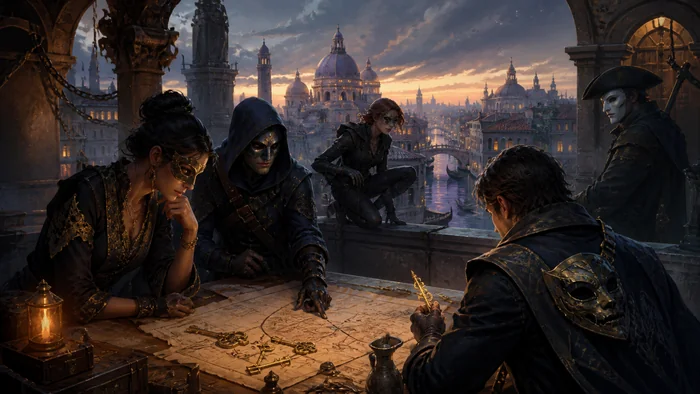
The Lies of Locke Lamora treats criminal performance as both art and survival. Locke and the Gentlemen Bastards do not simply steal; they create entire worlds for wealthy people to believe in, then disappear before the story collapses. Scott Lynch gives the crew a history of loyalty and damage, so every joke and impossible plan carries the knowledge that the city outside their confidence is more violent than the game they are pretending to play. Readers comparing books like The Lies of Locke Lamora will find that the most useful match depends on which part of the seed book created the strongest attachment: its voice, argument, setting, characters, problem, or promise of change.
The strongest books like The Lies of Locke Lamora should share more than a charming thief. They need a crew with distinct chemistry, a city organized by money and violence, elaborate deception, a threat that cannot be conned forever, and characters whose loyalty is both genuine and strategically dangerous. The recommendations below include fantasy heists, criminal underworlds, political infiltrations, and one or two more hopeful alternatives that still understand the cost of power.
The Best Con Is the One That Makes Everyone Feel Clever
Choose Red Seas Under Red Skies and The Republic of Thieves for the direct continuation, Six of Crows for a younger ensemble heist, and Foundryside for magical technology and urban theft. The Gilded Wolves adds historical puzzles; The Thief political deception; The Mask of Mirrors social infiltration; while The Blacktongue Thief, The Thousand Names, and The Traitor Baru Cormorant offer different mixes of wit, war, and compromise.
At-a-Glance Comparison
| Book | Best for | Major qualities shared with The Lies of Locke Lamora |
|---|---|---|
| Red Seas Under Red Skies | Readers who want the direct continuation, pirates, and another elaborate scheme | Locke and Jean, criminal partnership, deception, dangerous cities, political power, revenge, and a plan that becomes personal |
| The Republic of Thieves | Readers who want rivalry, history, and the cost of old loyalties | Criminal intelligence, rivalry, political manipulation, friendship, past and present timelines, performance, and betrayal |
| Six of Crows | Readers who want a younger crew and a high-stakes fantasy heist | A diverse ensemble, criminal city, specialized skills, found family, trauma, deception, and a mission that requires trust |
| Foundryside | Readers who want magical technology and a city-wide conspiracy | A criminal outsider, magical objects, merchant power, urban infrastructure, reluctant allies, and a theft that expands into revolution |
| The Gilded Wolves | Readers who want historical puzzles and a diverse found family | A heist crew, historical Paris, secret societies, artifacts, puzzles, class conflict, and specialized skills |
| The Thief | Readers who want an unreliable narrator and political deception | A skilled thief, hidden motives, travel, ancient objects, political intrigue, deception, and a narrator whose story is not what it seems |
| The Mask of Mirrors | Readers who want identity games and social infiltration | A false identity, a wealthy family, criminal networks, magic, class, performance, and a city built on secrets |
| The Blacktongue Thief | Readers who want a sharp first-person voice and a dangerous road | A witty thief, debt, war, monsters, reluctant companionship, criminal survival, and a narrator whose charm hides fear |
| The Traitor Baru Cormorant | Readers who want a political con played inside an empire | Infiltration, economic power, colonial assimilation, hidden identity, strategy, sacrifice, and rebellion from within |
What Makes a Strong Locke Lamora Companion?
Each book had to share at least two or three major qualities: a skilled outsider or criminal, an ensemble or found family, a city or institution shaped by wealth, elaborate deception, dark humor, betrayal, and a plot where personal history changes the practical plan. I did not select books simply because they contained thieves. The crew’s relationships and the mechanics of the con needed to drive the reading experience.
The 9 Recommended Books
Red Seas Under Red Skies

Overview: Locke and Jean leave Camorr and attempt to rob a powerful casino in a city ruled by political factions and maritime danger. Their plan is complicated by betrayal, forced service, and the limits of what a con can solve.
Why it belongs on this list: The shared qualities are locke and jean, criminal partnership, deception, dangerous cities, political power, revenge, and a plan that becomes personal. Red Seas Under Red Skies offers a neighboring reading experience through its characters, setting, tone, pacing, and treatment of consequence. The match is strongest for readers who want the direct continuation, pirates, and another elaborate scheme, although its emotional register and narrative structure may be quieter, stranger, or more expansive than the seed.
Reading experience: The direct continuation preserves the seed’s voice and crew relationship while changing the setting from canals and noble houses to ships, pirates, and a casino. It asks whether the Gentlemen Bastards can remain themselves when the city gives them no stable ground.
Best for: Readers who want the direct continuation, pirates, and another elaborate scheme.
Keep in mind: Broader, more adventurous, and more maritime, with a long setup before the central scheme pays off.
What to notice: Readers may begin Red Seas Under Red Skies for locke and jean, criminal partnership, deception, dangerous cities, political power, revenge, and a plan that becomes personal, then stay for the way the book complicates that attraction. The most revealing moments are often not the loudest ones: a change in loyalty, a detail of place, a silence between characters, or a choice that alters the meaning of an earlier scene. Those details give this recommendation a life beyond the seed title.
View available editions and reader reviews.
The Republic of Thieves

Overview: Locke and Jean are drawn into a political contest that brings Locke face to face with Sabetha, his former partner and rival. The present scheme is entangled with memories of the crew’s formation and the choices that divided them.
Why it belongs on this list: The shared qualities are criminal intelligence, rivalry, political manipulation, friendship, past and present timelines, performance, and betrayal. The Republic of Thieves offers a neighboring reading experience through its characters, setting, tone, pacing, and treatment of consequence. The match is strongest for readers who want rivalry, history, and the cost of old loyalties, although its emotional register and narrative structure may be quieter, stranger, or more expansive than the seed.
Reading experience: The book shifts the heist’s center from a physical vault to the history of relationships. It shares the seed’s wit and criminal intelligence while making identity, love, and loyalty as strategic as any con.
Best for: Readers who want rivalry, history, and the cost of old loyalties.
Keep in mind: More retrospective and relationship-focused, with flashbacks shaping the present plot.
What to notice: Choose The Republic of Thieves when the reader wants readers who want rivalry, history, and the cost of old loyalties but is open to a different tone and pace. Its shared qualities create a bridge to the seed, while its characters, setting, and structure make the journey distinct. The contrast can be as satisfying as the resemblance, especially for readers who want a familiar tension presented through new social or emotional circumstances.
View available editions and reader reviews.
Six of Crows

Overview: Kaz Brekker assembles six people with different abilities and reasons to distrust one another for an impossible prison heist. The plan depends on their skills, but the emotional danger comes from what each member cannot safely reveal.
Why it belongs on this list: The shared qualities are a diverse ensemble, criminal city, specialized skills, found family, trauma, deception, and a mission that requires trust. Six of Crows offers a neighboring reading experience through its characters, setting, tone, pacing, and treatment of consequence. The match is strongest for readers who want a younger crew and a high-stakes fantasy heist, although its emotional register and narrative structure may be quieter, stranger, or more expansive than the seed.
Reading experience: Kaz and Locke share strategic intelligence, criminal charisma, and a tendency to turn vulnerability into leverage. Bardugo is more openly ensemble-centered and YA in tone, but the city, crew chemistry, and mechanics of the heist are exceptionally close.
Best for: Readers who want a younger crew and a high-stakes fantasy heist.
Keep in mind: Fast, character-driven, and structured around plans, reversals, and alternating viewpoints.
What to notice: In Six of Crows, a diverse ensemble, criminal city, specialized skills, found family, trauma, deception, and a mission that requires trust are part of the story’s emotional architecture. Notice how the characters move through the setting, how quickly the plot reveals its information, and whether the book offers closure or leaves room for unease. Those choices explain why it belongs on this list more clearly than a surface genre label would.
View available editions and reader reviews.
Foundryside

Overview: Sancia can understand the secret commands inside objects, a talent that helps her steal a dangerous artifact. The theft exposes a conflict among merchant dynasties and the magical technology holding the city together.
Why it belongs on this list: The shared qualities are a criminal outsider, magical objects, merchant power, urban infrastructure, reluctant allies, and a theft that expands into revolution. Foundryside offers a neighboring reading experience through its characters, setting, tone, pacing, and treatment of consequence. The match is strongest for readers who want magical technology and a city-wide conspiracy, although its emotional register and narrative structure may be quieter, stranger, or more expansive than the seed.
Reading experience: The book shares the seed’s city-based crime, specialized skill, impossible object, and gradual realization that a private job is connected to public power. Its magic is mechanical and its crew forms more slowly, but the strategic pleasure is similar.
Best for: Readers who want magical technology and a city-wide conspiracy.
Keep in mind: Inventive, kinetic, and more focused on systems and magical engineering.
What to notice: The strongest connection between Foundryside and the seed is found in a criminal outsider, magical objects, merchant power, urban infrastructure, reluctant allies, and a theft that expands into revolution, but the reading experience is deliberately different. Its tone, narrative distance, and treatment of consequence create another route into the same broad pleasure. Readers should let the book establish its own rhythm before judging it against the original.
View available editions and reader reviews.
The Gilded Wolves

Overview: Séverin and his companions pursue a secret society’s dangerous legacy through nineteenth-century Paris. The group’s skills in languages, history, engineering, and combat make each puzzle both intellectual and personal.
Why it belongs on this list: The shared qualities are a heist crew, historical paris, secret societies, artifacts, puzzles, class conflict, and specialized skills. The Gilded Wolves offers a neighboring reading experience through its characters, setting, tone, pacing, and treatment of consequence. The match is strongest for readers who want historical puzzles and a diverse found family, although its emotional register and narrative structure may be quieter, stranger, or more expansive than the seed.
Reading experience: The book offers a younger, more historical version of the seed’s crew pleasure. It emphasizes artifacts, research, and social exclusion, while the ensemble’s relationships create the risk that a successful mission will still cost someone their future.
Best for: Readers who want historical puzzles and a diverse found family.
Keep in mind: Atmospheric, puzzle-driven, and ensemble-focused, with a decorative historical setting.
What to notice: In The Gilded Wolves, a heist crew, historical paris, secret societies, artifacts, puzzles, class conflict, and specialized skills are part of the story’s emotional architecture. Notice how the characters move through the setting, how quickly the plot reveals its information, and whether the book offers closure or leaves room for unease. Those choices explain why it belongs on this list more clearly than a surface genre label would.
View available editions and reader reviews.
The Thief

Overview: Gen is recruited for a journey to steal an ancient artifact, but his boasting, imprisonment, and apparent incompetence conceal a more complicated role in the political conflict.
Why it belongs on this list: The shared qualities are a skilled thief, hidden motives, travel, ancient objects, political intrigue, deception, and a narrator whose story is not what it seems. The Thief offers a neighboring reading experience through its characters, setting, tone, pacing, and treatment of consequence. The match is strongest for readers who want an unreliable narrator and political deception, although its emotional register and narrative structure may be quieter, stranger, or more expansive than the seed.
Reading experience: Locke performs confidence while Gen performs foolishness. Both books make the reader reconsider what competence looks like and who is controlling the story, though Turner is quieter and more formally economical.
Best for: Readers who want an unreliable narrator and political deception.
Keep in mind: Compact, witty, and increasingly political, with a major reinterpretation of the narrator.
What to notice: Readers may begin The Thief for a skilled thief, hidden motives, travel, ancient objects, political intrigue, deception, and a narrator whose story is not what it seems, then stay for the way the book complicates that attraction. The most revealing moments are often not the loudest ones: a change in loyalty, a detail of place, a silence between characters, or a choice that alters the meaning of an earlier scene. Those details give this recommendation a life beyond the seed title.
View available editions and reader reviews.
The Mask of Mirrors

Overview: Ren enters a noble household under a false identity and becomes entangled in the political, criminal, and magical structures of Nadežra. Every role gives her access while making discovery more dangerous.
Why it belongs on this list: The shared qualities are a false identity, a wealthy family, criminal networks, magic, class, performance, and a city built on secrets. The Mask of Mirrors offers a neighboring reading experience through its characters, setting, tone, pacing, and treatment of consequence. The match is strongest for readers who want identity games and social infiltration, although its emotional register and narrative structure may be quieter, stranger, or more expansive than the seed.
Reading experience: The book treats social identity as a con whose success depends on reading people, hierarchy, and space. It is slower and more layered than Locke’s capers, but both protagonists survive through performance while longing for a loyalty that is not transactional.
Best for: Readers who want identity games and social infiltration.
Keep in mind: Dense, atmospheric, and gradually revealing, with a strong city and factional structure.
What to notice: Readers may begin The Mask of Mirrors for a false identity, a wealthy family, criminal networks, magic, class, performance, and a city built on secrets, then stay for the way the book complicates that attraction. The most revealing moments are often not the loudest ones: a change in loyalty, a detail of place, a silence between characters, or a choice that alters the meaning of an earlier scene. Those details give this recommendation a life beyond the seed title.
View available editions and reader reviews.
The Blacktongue Thief

Overview: Kinch Na Shannack is a thief trained by a guild that has left him deeply in debt. His attempt to rob a traveler becomes a journey involving war, monsters, old powers, and a companion who refuses to be manipulated easily.
Why it belongs on this list: The shared qualities are a witty thief, debt, war, monsters, reluctant companionship, criminal survival, and a narrator whose charm hides fear. The Blacktongue Thief offers a neighboring reading experience through its characters, setting, tone, pacing, and treatment of consequence. The match is strongest for readers who want a sharp first-person voice and a dangerous road, although its emotional register and narrative structure may be quieter, stranger, or more expansive than the seed.
Reading experience: Kinch shares Locke’s verbal agility and criminal training, but the road structure makes the story more improvisational. Both books let a funny narrator use performance to survive while gradually exposing the emotional cost underneath.
Best for: Readers who want a sharp first-person voice and a dangerous road.
Keep in mind: Voice-driven, irreverent, and more travel-focused than a contained city heist.
What to notice: The strongest connection between The Blacktongue Thief and the seed is found in a witty thief, debt, war, monsters, reluctant companionship, criminal survival, and a narrator whose charm hides fear, but the reading experience is deliberately different. Its tone, narrative distance, and treatment of consequence create another route into the same broad pleasure. Readers should let the book establish its own rhythm before judging it against the original.
View available editions and reader reviews.
The Traitor Baru Cormorant

Overview: Baru enters the administrative machinery of the empire that conquered her island, intending to use its own systems against it. Her intelligence opens doors, but each compromise threatens the people and relationships she wants to protect.
Why it belongs on this list: The shared qualities are infiltration, economic power, colonial assimilation, hidden identity, strategy, sacrifice, and rebellion from within. The Traitor Baru Cormorant offers a neighboring reading experience through its characters, setting, tone, pacing, and treatment of consequence. The match is strongest for readers who want a political con played inside an empire, although its emotional register and narrative structure may be quieter, stranger, or more expansive than the seed.
Reading experience: Baru’s entire career becomes a con whose stakes exceed personal survival. The novel is less comic and more analytical than Lynch, but it shares the question of whether a gifted outsider can manipulate a system without allowing the system to manipulate every part of her.
Best for: Readers who want a political con played inside an empire.
Keep in mind: Slow-burning, cerebral, and emotionally severe, with political decisions as the main action.
What to notice: The strongest connection between The Traitor Baru Cormorant and the seed is found in infiltration, economic power, colonial assimilation, hidden identity, strategy, sacrifice, and rebellion from within, but the reading experience is deliberately different. Its tone, narrative distance, and treatment of consequence create another route into the same broad pleasure. Readers should let the book establish its own rhythm before judging it against the original.
View available editions and reader reviews.
Choose by Crew, Heist, Social Infiltration, or War
Start with Red Seas Under Red Skies for more Locke and Jean, or The Republic of Thieves for rivalry and history. Six of Crows is the strongest YA heist; Foundryside for magical machinery; and The Gilded Wolves for historical puzzles. Choose The Mask of Mirrors for identity and social access, The Thief for political deception, The Blacktongue Thief for voice, The Thousand Names for military strategy, and The Traitor Baru Cormorant for empire and compromise.
Who This List Is Best For
This list is for adult and older teen fantasy readers who enjoy thieves, con artists, morally gray friendships, city politics, banter, and schemes that become more dangerous as they succeed. Several books include torture, sexual violence, slavery, addiction, colonialism, and war. The YA choices are not automatically lighter; check their content and tone individually.
FAQ
What is the closest book to The Lies of Locke Lamora?
Red Seas Under Red Skies and The Republic of Thieves are the direct continuations. Outside the series, Six of Crows is the closest for a crew-based fantasy heist, while Foundryside is closest in urban magical schemes.
Which book has the best criminal crew?
Six of Crows offers the most character-balanced ensemble, while The Blacktongue Thief relies more on a single voice and The Gilded Wolves on puzzle-solving chemistry.
Which recommendation is most humorous?
Lynch’s own books are the closest match for criminal banter. The Blacktongue Thief and Six of Crows also use humor to make danger and trauma readable without making them harmless.
Which book focuses most on identity and disguise?
The Mask of Mirrors makes social identity and imposture central. The Thief uses deception more quietly, through narration and political misdirection.
Are these books suitable for younger readers?
Six of Crows and The Gilded Wolves are common YA or crossover choices, but they still include violence and trauma. Lynch’s series and several others are adult and much more explicit.
A Crew Is a Home with the Locks on the Inside
The Lies of Locke Lamora is remembered for its schemes, but the schemes work because the Gentlemen Bastards have built a private language of loyalty around them. The companion books offer different crews, cities, magic systems, and betrayals. Their shared pleasure is watching competence become intimate: a disguise, a joke, a hidden route, or a second plan matters because someone knows exactly who will take the risk.