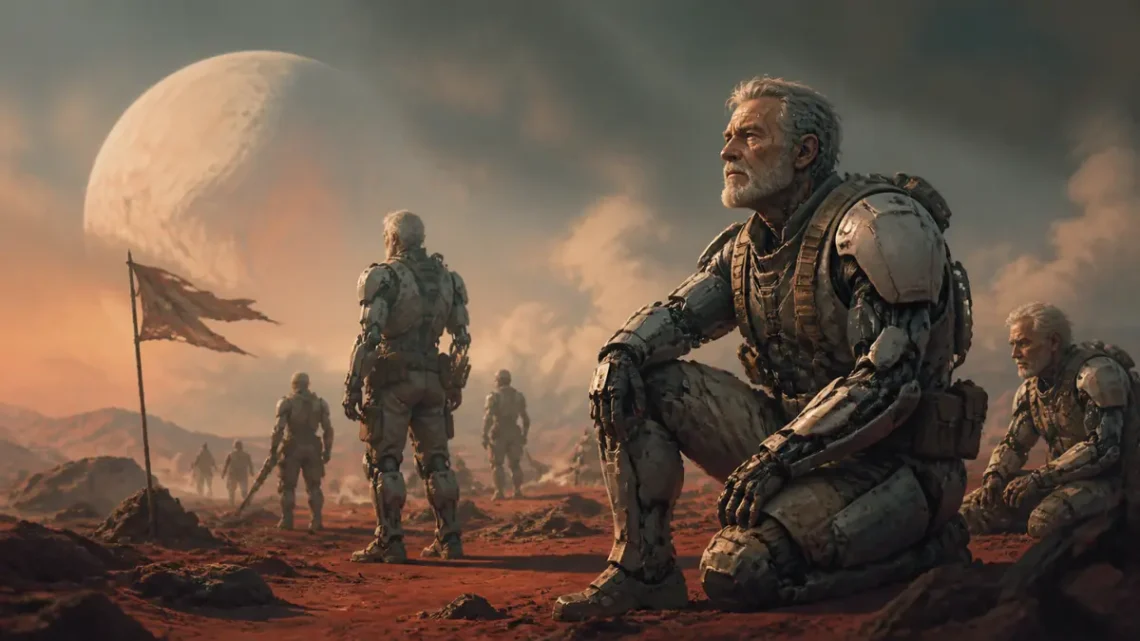
Old Man’s War begins with an appealing bargain: join the Colonial Defense Forces at seventy-five, receive a young body, and spend your final years among the stars. John Perry discovers that the bargain is also a way of hiding the cost of colonization. The novel’s humor and military momentum make the story easy to enter, but its most interesting questions arrive when the new body, the new squad, and the new enemy stop feeling like simple upgrades or targets. Readers comparing books like Old Man’s War will find that the most useful match depends on which part of the seed book created the strongest attachment: its voice, argument, setting, characters, problem, or promise of change.
The strongest books like Old Man’s War need more than soldiers in space. They should share at least two or three major qualities: recruitment or training, altered bodies or extended life, a unit whose relationships carry the emotional story, alien or colonial conflict, and a protagonist discovering that military necessity does not erase moral responsibility. The recommendations below range from light military adventure to darker antiwar science fiction.
A New Body Does Not Give You a New Moral History
Choose The Forever War for time dilation and antiwar irony, Armor for a more brutal soldier’s perspective, and Ender’s Game for training and strategic manipulation. The Expanse adds politics and crews, Starship Troopers the classic military argument, and Ancillary Justice, Terms of Enlistment, Red Rising, and The Light Brigade explore bodies, empire, and service in different ways.
At-a-Glance Comparison
| Book | Best for | Major qualities shared with Old Man’s War |
|---|---|---|
| The Forever War | Readers who want time dilation, military service, and antiwar irony | Interstellar war, altered aging, military training, distance from home, institutional obedience, sexuality, and the absurdity of fighting an enemy across time |
| Armor | Readers who want a brutal, psychologically damaged soldier’s perspective | Alien combat, powered armor, trauma, identity, survival, military exploitation, and a protagonist whose body becomes a tool for an institution |
| Ender’s Game | Readers who want military training, gifted children, and strategic manipulation | Institutional training, simulated combat, gifted protagonists, manipulation, leadership, alien conflict, and a young person used by adults who hide the real stakes |
| Starship Troopers | Readers who want classic military science fiction and an argument about citizenship | Military training, infantry combat, civic duty, alien war, hierarchy, discipline, and the relationship between service and political rights |
| The Expanse: Leviathan Wakes | Readers who want a crew, political factions, and military danger in a divided solar system | Shipboard life, crew loyalty, political conflict, alien technology, investigation, military escalation, and ordinary people caught inside a larger war |
| Ancillary Justice | Readers who want distributed bodies and an artificial soldier’s identity | Multiple bodies, military empire, artificial intelligence, colonial power, memory, loyalty, and a protagonist carrying the history of a lost ship |
| Terms of Enlistment | Readers who want recruitment, military service, and a future shaped by enlistment | Military recruitment, future service, training, class, squad loyalty, alien conflict, and a young person discovering the terms behind an attractive contract |
| Red Rising | Readers who want caste rebellion, bodily transformation, and military spectacle | Class hierarchy, altered bodies, elite training, rebellion, war, strategic alliances, identity performance, and a protagonist using the ruling system against itself |
| The Light Brigade | Readers who want military teleportation, fractured identity, and corporate war | Military service, altered bodies, time distortion, corporate power, memory, class conflict, and a soldier discovering that history is not stable |
What Makes a Strong Old Man’s War Companion?
Each book needed a real connection to military identity and altered embodiment. I looked for training, deployment, unit loyalty, aging or bodily transformation, and a political system that frames violence as necessary. Humor is one route, but not a requirement; the darker books belong because they question the same promise that service will turn personal sacrifice into a clean form of duty.
The 9 Recommended Books
The Forever War

Overview: William Mandella joins a war against an alien species and experiences time dilation that makes each deployment separate him further from the society he left. Military service changes his body, relationships, and sense of history.
Why it belongs on this list: The shared qualities are interstellar war, altered aging, military training, distance from home, institutional obedience, sexuality, and the absurdity of fighting an enemy across time. The Forever War offers a neighboring reading experience through its characters, setting, tone, pacing, and treatment of consequence. The match is strongest for readers who want time dilation, military service, and antiwar irony, although its emotional register and narrative structure may be quieter, stranger, or more expansive than the seed.
Reading experience: The books share the premise that technology changes the soldier’s experience of time and identity. Haldeman is more explicitly antiwar and structurally shaped by Vietnam-era disillusionment, while Scalzi uses humor before revealing the system’s cost.
Best for: Readers who want time dilation, military service, and antiwar irony.
Keep in mind: Fast, direct, and conceptually sharp, with combat, training, and social changes compressed by time dilation.
What to notice: What matters most in The Forever War is the way interstellar war, altered aging, military training, distance from home, institutional obedience, sexuality, and the absurdity of fighting an enemy across time shapes the characters’ lives and the world around them. The resemblance to the seed is not limited to a premise. Pay attention to voice, pacing, setting, and the small choices that reveal how this book imagines danger, loyalty, or belonging.
View available editions and reader reviews.
Armor
Overview: Felix is a soldier whose combat experience on an alien planet becomes a cycle of fear, endurance, and institutional use. The novel moves through multiple perspectives, showing how war creates both victims and people who learn to weaponize themselves.
Why it belongs on this list: The shared qualities are alien combat, powered armor, trauma, identity, survival, military exploitation, and a protagonist whose body becomes a tool for an institution. Armor offers a neighboring reading experience through its characters, setting, tone, pacing, and treatment of consequence. The match is strongest for readers who want a brutal, psychologically damaged soldier’s perspective, although its emotional register and narrative structure may be quieter, stranger, or more expansive than the seed.
Reading experience: This is the darker answer to the seed’s comic military adventure. It shares altered bodies, alien conflict, and the distance between recruitment promises and battlefield reality, but it offers far less comfort about humor, friendship, or institutional purpose.
Best for: Readers who want a brutal, psychologically damaged soldier’s perspective.
Keep in mind: Intense, brutal, and psychologically claustrophobic, with combat scenes and fractured perspectives.
What to notice: What matters most in Armor is the way alien combat, powered armor, trauma, identity, survival, military exploitation, and a protagonist whose body becomes a tool for an institution shapes the characters’ lives and the world around them. The resemblance to the seed is not limited to a premise. Pay attention to voice, pacing, setting, and the small choices that reveal how this book imagines danger, loyalty, or belonging.
View available editions and reader reviews.
Ender’s Game

Overview: Ender Wiggin is sent to Battle School, where games and competition train children for a war against an alien species. His intelligence and empathy make him effective, but also make him vulnerable to adults who need a weapon.
Why it belongs on this list: The shared qualities are institutional training, simulated combat, gifted protagonists, manipulation, leadership, alien conflict, and a young person used by adults who hide the real stakes. Ender’s Game offers a neighboring reading experience through its characters, setting, tone, pacing, and treatment of consequence. The match is strongest for readers who want military training, gifted children, and strategic manipulation, although its emotional register and narrative structure may be quieter, stranger, or more expansive than the seed.
Reading experience: The shared question is how an institution turns a person’s unusual ability into military property. Ender is younger and the tone more tactical, but both books use humor, training, and friendship to lead readers toward moral unease.
Best for: Readers who want military training, gifted children, and strategic manipulation.
Keep in mind: Fast, strategic, and accessible, with games, rivalries, and a large ethical reversal.
What to notice: In Ender’s Game, institutional training, simulated combat, gifted protagonists, manipulation, leadership, alien conflict, and a young person used by adults who hide the real stakes are part of the story’s emotional architecture. Notice how the characters move through the setting, how quickly the plot reveals its information, and whether the book offers closure or leaves room for unease. Those choices explain why it belongs on this list more clearly than a surface genre label would.
View available editions and reader reviews.
Starship Troopers

Overview: Johnny Rico joins the Mobile Infantry and learns the work, discipline, and ideology of military service during a war with the Bugs. The novel alternates action with long discussions about citizenship, violence, and responsibility.
Why it belongs on this list: The shared qualities are military training, infantry combat, civic duty, alien war, hierarchy, discipline, and the relationship between service and political rights. Starship Troopers offers a neighboring reading experience through its characters, setting, tone, pacing, and treatment of consequence. The match is strongest for readers who want classic military science fiction and an argument about citizenship, although its emotional register and narrative structure may be quieter, stranger, or more expansive than the seed.
Reading experience: It is a useful ideological contrast. Like Old Man’s War, it makes military service a route into questions about society, but Heinlein is more openly argumentative about duty and citizenship, while Scalzi is more skeptical and comic.
Best for: Readers who want classic military science fiction and an argument about citizenship.
Keep in mind: Training and combat are balanced by extended political discussion; the pace is more essayistic than the seed.
What to notice: In Starship Troopers, military training, infantry combat, civic duty, alien war, hierarchy, discipline, and the relationship between service and political rights are part of the story’s emotional architecture. Notice how the characters move through the setting, how quickly the plot reveals its information, and whether the book offers closure or leaves room for unease. Those choices explain why it belongs on this list more clearly than a surface genre label would.
View available editions and reader reviews.
The Expanse: Leviathan Wakes

Overview: Holden’s crew and detective Miller become involved in a conspiracy that moves from a missing ship to a system-wide crisis. Earth, Mars, and the Belt bring different histories and political needs to the same dangerous discovery.
Why it belongs on this list: The shared qualities are shipboard life, crew loyalty, political conflict, alien technology, investigation, military escalation, and ordinary people caught inside a larger war. The Expanse: Leviathan Wakes offers a neighboring reading experience through its characters, setting, tone, pacing, and treatment of consequence. The match is strongest for readers who want a crew, political factions, and military danger in a divided solar system, although its emotional register and narrative structure may be quieter, stranger, or more expansive than the seed.
Reading experience: The connection is the human-scale crew inside a civilizational conflict. The Expanse is less focused on altered aging and more on class, labor, and politics, but it shares the seed’s ability to make banter and practical work carry moral weight.
Best for: Readers who want a crew, political factions, and military danger in a divided solar system.
Keep in mind: Cinematic, propulsive, and ensemble-driven, with investigation, shipboard action, and political tension.
What to notice: Choose The Expanse: Leviathan Wakes when the reader wants readers who want a crew, political factions, and military danger in a divided solar system but is open to a different tone and pace. Its shared qualities create a bridge to the seed, while its characters, setting, and structure make the journey distinct. The contrast can be as satisfying as the resemblance, especially for readers who want a familiar tension presented through new social or emotional circumstances.
View available editions and reader reviews.
Ancillary Justice

Overview: Breq was once a starship intelligence controlling thousands of ancillary bodies. Now confined to one human body, she pursues a mission through an empire whose ruler has split into competing selves.
Why it belongs on this list: The shared qualities are multiple bodies, military empire, artificial intelligence, colonial power, memory, loyalty, and a protagonist carrying the history of a lost ship. Ancillary Justice offers a neighboring reading experience through its characters, setting, tone, pacing, and treatment of consequence. The match is strongest for readers who want distributed bodies and an artificial soldier’s identity, although its emotional register and narrative structure may be quieter, stranger, or more expansive than the seed.
Reading experience: Both novels ask what a military body is when technology changes the relationship between person, equipment, and command. Leckie is more political and less humorous, but the question of service and identity is deeply compatible.
Best for: Readers who want distributed bodies and an artificial soldier’s identity.
Keep in mind: Measured, political, and perception-driven, with identity revealed through the narrator’s unusual relation to bodies and gender.
What to notice: In Ancillary Justice, multiple bodies, military empire, artificial intelligence, colonial power, memory, loyalty, and a protagonist carrying the history of a lost ship are part of the story’s emotional architecture. Notice how the characters move through the setting, how quickly the plot reveals its information, and whether the book offers closure or leaves room for unease. Those choices explain why it belongs on this list more clearly than a surface genre label would.
View available editions and reader reviews.
Terms of Enlistment
Overview: Andrew Grayson joins the North American Commonwealth Defense Force to escape a constrained life and gain access to a future he could not afford. Training and deployment reveal how much the enlistment promise hides.
Why it belongs on this list: The shared qualities are military recruitment, future service, training, class, squad loyalty, alien conflict, and a young person discovering the terms behind an attractive contract. Terms of Enlistment offers a neighboring reading experience through its characters, setting, tone, pacing, and treatment of consequence. The match is strongest for readers who want recruitment, military service, and a future shaped by enlistment, although its emotional register and narrative structure may be quieter, stranger, or more expansive than the seed.
Reading experience: The match is the recruitment premise and the ordinary soldier’s perspective. It is more straightforward and less philosophically ambitious than Scalzi, but it keeps attention on service as a social and economic choice.
Best for: Readers who want recruitment, military service, and a future shaped by enlistment.
Keep in mind: Fast, accessible, and action-forward, with training, deployment, and squad relationships.
What to notice: Readers may begin Terms of Enlistment for military recruitment, future service, training, class, squad loyalty, alien conflict, and a young person discovering the terms behind an attractive contract, then stay for the way the book complicates that attraction. The most revealing moments are often not the loudest ones: a change in loyalty, a detail of place, a silence between characters, or a choice that alters the meaning of an earlier scene. Those details give this recommendation a life beyond the seed title.
View available editions and reader reviews.
Red Rising

Overview: Darrow is transformed to infiltrate the ruling caste after the mining society he belongs to is exposed as a political prison. An elite war game becomes the beginning of a much larger rebellion.
Why it belongs on this list: The shared qualities are class hierarchy, altered bodies, elite training, rebellion, war, strategic alliances, identity performance, and a protagonist using the ruling system against itself. Red Rising offers a neighboring reading experience through its characters, setting, tone, pacing, and treatment of consequence. The match is strongest for readers who want caste rebellion, bodily transformation, and military spectacle, although its emotional register and narrative structure may be quieter, stranger, or more expansive than the seed.
Reading experience: The shared appeal is the way institutions turn bodies and talent into weapons. Brown is more operatic and class-focused, while Old Man’s War is more conversational and military-professional, but both question the stories that make service seem honorable to everyone involved.
Best for: Readers who want caste rebellion, bodily transformation, and military spectacle.
Keep in mind: Fast, brutal, and cinematic, with academy competition leading into war and political rebellion.
What to notice: What matters most in Red Rising is the way class hierarchy, altered bodies, elite training, rebellion, war, strategic alliances, identity performance, and a protagonist using the ruling system against itself shapes the characters’ lives and the world around them. The resemblance to the seed is not limited to a premise. Pay attention to voice, pacing, setting, and the small choices that reveal how this book imagines danger, loyalty, or belonging.
View available editions and reader reviews.
The Light Brigade
Overview: Dietz joins a corporate military and is transformed into a light-based soldier who experiences battles out of chronological order. Each deployment reveals a different version of the war and the corporation’s role in it.
Why it belongs on this list: The shared qualities are military service, altered bodies, time distortion, corporate power, memory, class conflict, and a soldier discovering that history is not stable. The Light Brigade offers a neighboring reading experience through its characters, setting, tone, pacing, and treatment of consequence. The match is strongest for readers who want military teleportation, fractured identity, and corporate war, although its emotional register and narrative structure may be quieter, stranger, or more expansive than the seed.
Reading experience: This is the most formally inventive companion. Like the seed, it combines military action with questions about aging, body, loyalty, and institutional truth, but the time structure makes identity itself part of the battlefield.
Best for: Readers who want military teleportation, fractured identity, and corporate war.
Keep in mind: Short, intense, and nonlinear, with combat scenes and a reality-fracturing plot.
What to notice: In The Light Brigade, military service, altered bodies, time distortion, corporate power, memory, class conflict, and a soldier discovering that history is not stable are part of the story’s emotional architecture. Notice how the characters move through the setting, how quickly the plot reveals its information, and whether the book offers closure or leaves room for unease. Those choices explain why it belongs on this list more clearly than a surface genre label would.
View available editions and reader reviews.
Choose by Humor, Antiwar Thought, Training, or Body Transformation
Start with The Forever War for the clearest antiwar and time-dilation counterpart, or Ender’s Game for training shaped by manipulation. Armor is the darkest soldier’s narrative; Starship Troopers the most argumentative; and The Expanse the political-crew route. Choose Ancillary Justice for distributed bodies, Terms of Enlistment for enlistment and service, Red Rising for caste rebellion, and The Light Brigade for identity fractured by military technology.
Who This List Is Best For
This list is for adult and crossover military-science-fiction readers who enjoy squad dynamics, altered bodies, training, and moral questions beneath action. War, colonial violence, torture, death, body horror, sexual violence, and psychological trauma appear. The recommendations differ in humor, political complexity, and how sympathetic they are toward military institutions.
FAQ
What is the closest book to Old Man’s War?
The Forever War is closest in its military science-fiction structure, altered experience of time, and antiwar questions. Terms of Enlistment is a closer match for recruitment and future military service, while The Expanse adds politics and crews.
Which recommendation is the funniest?
The Expanse and Old Man’s War share the strongest banter and crew humor. Starship Troopers is more argumentative than comic, while Red Rising uses a sharper and more brutal style.
Which book is the most antiwar?
The Forever War and Armor are the most openly hostile to the narratives that make war appear clean or necessary. The Light Brigade and The Expanse also examine the political costs of military service.
Which books have altered bodies?
Old Man’s War, Ancillary Justice, The Light Brigade, and Terms of Enlistment all use bodily transformation or technological intervention differently. Red Rising makes transformation part of class infiltration.
Are these suitable for younger readers?
Ender’s Game and parts of Red Rising are common crossover choices, but they include violence, manipulation, war, and trauma. Most of the list is adult military science fiction with graphic or disturbing material.
The Uniform Is Not the Same Thing as the Person Wearing It
Old Man’s War is most effective when its jokes expose the distance between a soldier’s new body and the history inside it. The companion books carry that insight into other armies and technologies. Some make service a civic argument, some a trap, and some a form of survival, but each asks what remains morally personal when an institution claims the body as equipment.