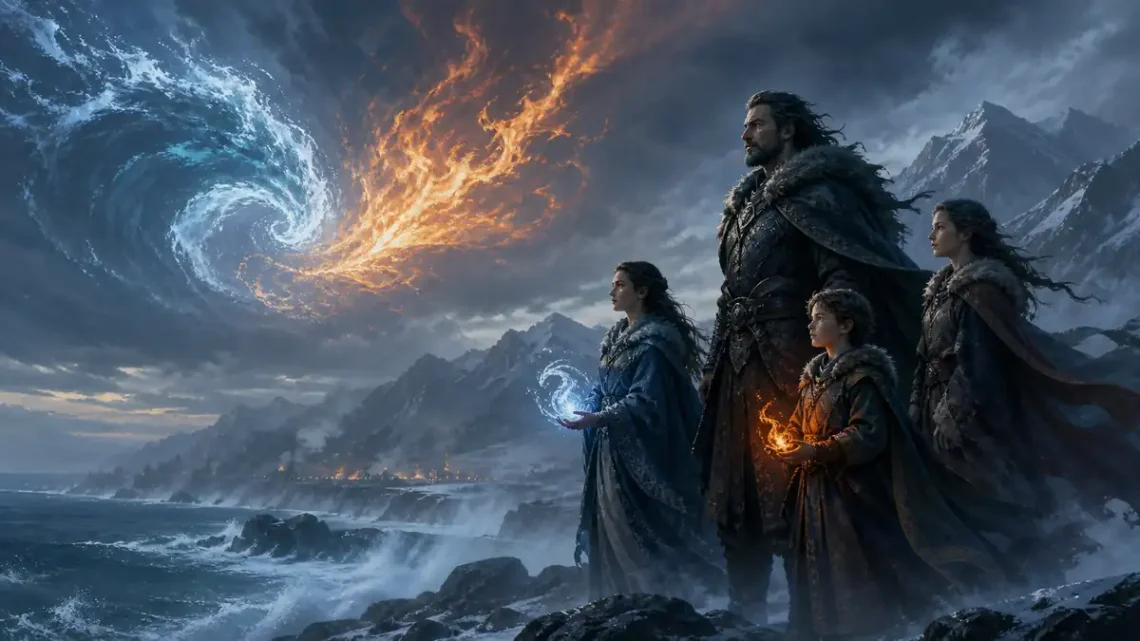
The Sword of Kaigen is powerful because its elemental spectacle never overwhelms the family at its center. The Matsuda household has been trained to embody a national ideal: disciplined, proud, secretive, and ready to defend a coastline that has not faced a true threat for generations. When war arrives, Misaki’s buried history and Mamoru’s inherited duty collide, and the novel becomes as much about marriage, parenthood, and survival as it is about ice and water. Readers comparing books like The Sword of Kaigen will find that the most useful match depends on which part of the seed book created the strongest attachment: its voice, argument, setting, characters, problem, or promise of change.
A useful companion must share more than “elemental magic.” These recommendations were chosen for at least three qualities such as military or clan duty, a family under pressure, a culture shaped by war, disciplined magic, grief, political secrecy, or a protagonist forced to reconsider an inherited role. Some are epic and large-scale; others keep the camera close to a household, a village, or a single generation.
A War Reaches the House That Was Supposed to Protect Them
Choose The Poppy War for the harshest military transformation, Jade City for family power and elemental tradition, or The Grace of Kings for a wider political canvas. The Rage of Dragons is the most relentless training-and-revenge route, The Dragon Republic continues Rin’s war, and The Bone Shard Daughter, The Sword of Kaigen‘s closest emotional cousins, Black Sun, The Tiger and the Wolf, and She Who Became the Sun bring different cultures and identities into the conflict.
At-a-Glance Comparison
| Book | Best for | Major qualities shared with The Sword of Kaigen |
|---|---|---|
| Jade City | Readers who want family loyalty, elemental power, and clan politics | A family-centered power structure, magical resources, cultural identity, political rivalry, war, and characters shaped by inherited duty |
| The Poppy War | Readers who want military school, divine power, and a devastating war arc | A poor outsider, elite training, spiritual power, national conflict, colonial violence, and a protagonist changed by what war permits |
| The Grace of Kings | Readers who want archipelago politics, rebellion, and large-scale cultural change | Island kingdoms, rebellion, military strategy, family and friendship, gods, political legitimacy, and a world reshaped by war |
| The Rage of Dragons | Readers who want relentless training, revenge, and combat-driven fantasy | A rigid warrior society, inherited violence, magical combat training, family loss, class hierarchy, and a protagonist consumed by revenge |
| The Dragon Republic | Readers who want the next stage of Rin’s war and political fracture | Military campaigns, elemental or divine power, divided loyalties, political betrayal, trauma, and a protagonist trying to survive the consequences of earlier choices |
| The Bone Shard Daughter | Readers who want memory, identity, empire, and intimate resistance | An authoritarian empire, body-based magic, fragmented identity, family secrets, political rebellion, and characters whose private histories challenge official power |
| Black Sun | Readers who want prophecy, empire, religion, and culturally specific world-building | Rival political factions, sacred power, colonial history, family or social duty, sea travel, prophecy, and a world approaching violent change |
| The Tiger and the Wolf | Readers who want clan identity, shapeshifting, and family history in a harsh world | Tribal culture, inherited identity, family conflict, shapeshifting, war, old magic, and a protagonist caught between personal freedom and collective duty |
| She Who Became the Sun | Readers who want ambition, gender, war, and historical transformation | A child shaped by famine, assumed identity, military rise, religious destiny, political conflict, and the price of refusing an assigned fate |
What Makes a Strong Sword of Kaigen Companion?
I prioritized books in which power is inherited through family, clan, nation, or military training, and in which using that power changes intimate relationships. The choices also needed a distinctive cultural setting, real consequences for war, and characters whose inner lives are not reduced to a heroic mission. A flashy magic system without family pressure or political consequence was not enough.
The 9 Recommended Books
Jade City

Overview: In the city of Janloon, jade grants physical abilities to those trained to use it, and the No Peak clan has protected its territory for generations. Brothers Kaul Hilo and Kaul Lan inherit both a political conflict and a family role, while a rival clan’s ambitions turn old rules into a city-wide crisis.
Why it belongs on this list: The shared qualities are a family-centered power structure, magical resources, cultural identity, political rivalry, war, and characters shaped by inherited duty. Jade City offers a neighboring reading experience through its characters, setting, tone, pacing, and treatment of consequence. The match is strongest for readers who want family loyalty, elemental power, and clan politics, although its emotional register and narrative structure may be quieter, stranger, or more expansive than the seed.
Reading experience: This is the strongest companion for readers who loved how a national ideal presses into family life. The magic is less spectacular than Misaki’s water and Mamoru’s ice, but jade is equally cultural, bodily, and political; it decides who belongs, who leads, and what sacrifice the family can demand.
Best for: Readers who want family loyalty, elemental power, and clan politics.
Keep in mind: Layered, urban, and character-rich, with gang politics, ceremonies, commerce, romance, and sudden violence. The pacing is broader and more ensemble-based than Wang’s intimate household focus.
What to notice: Readers may begin Jade City for a family-centered power structure, magical resources, cultural identity, political rivalry, war, and characters shaped by inherited duty, then stay for the way the book complicates that attraction. The most revealing moments are often not the loudest ones: a change in loyalty, a detail of place, a silence between characters, or a choice that alters the meaning of an earlier scene. Those details give this recommendation a life beyond the seed title.
View available editions and reader reviews.
The Poppy War

Overview: Rin escapes an arranged marriage by succeeding in a national examination and entering Sinegard’s military academy. Her unusual connection to gods makes her valuable, but the empire’s war exposes the brutality behind the education and the patriotic stories she has inherited.
Why it belongs on this list: The shared qualities are a poor outsider, elite training, spiritual power, national conflict, colonial violence, and a protagonist changed by what war permits. The Poppy War offers a neighboring reading experience through its characters, setting, tone, pacing, and treatment of consequence. The match is strongest for readers who want military school, divine power, and a devastating war arc, although its emotional register and narrative structure may be quieter, stranger, or more expansive than the seed.
Reading experience: Both novels examine what happens when a disciplined young person is asked to turn identity into a weapon. Kuang is more explicitly historical and much more brutal, while Wang stays closer to a family and a coastal community, but both refuse to make military power emotionally clean.
Best for: Readers who want military school, divine power, and a devastating war arc.
Keep in mind: The first part is competitive and school-centered; the later sections become fast, tragic, and increasingly horrifying.
What to notice: Choose The Poppy War when the reader wants readers who want military school, divine power, and a devastating war arc but is open to a different tone and pace. Its shared qualities create a bridge to the seed, while its characters, setting, and structure make the journey distinct. The contrast can be as satisfying as the resemblance, especially for readers who want a familiar tension presented through new social or emotional circumstances.
View available editions and reader reviews.
The Grace of Kings

Overview: Kuni Garu is a charming bandit and Mata Zyndu is an aristocratic warrior, yet both become central to the upheaval of the Dara archipelago. Their friendship and rivalry move through rebellion, conquest, invention, and the difficult work of ruling after a dynasty falls.
Why it belongs on this list: The shared qualities are island kingdoms, rebellion, military strategy, family and friendship, gods, political legitimacy, and a world reshaped by war. The Grace of Kings offers a neighboring reading experience through its characters, setting, tone, pacing, and treatment of consequence. The match is strongest for readers who want archipelago politics, rebellion, and large-scale cultural change, although its emotional register and narrative structure may be quieter, stranger, or more expansive than the seed.
Reading experience: The novel shares the seed’s attention to culture, duty, and the cost of political transformation, but it pulls the camera far back. Readers who want the war to reshape nations rather than one village will find a broader, more strategic version of inherited power and loyalty.
Best for: Readers who want archipelago politics, rebellion, and large-scale cultural change.
Keep in mind: Epic, panoramic, and full of armies, islands, inventions, and shifts in political order. It is more historical in structure and less intimate in narration.
What to notice: Choose The Grace of Kings when the reader wants readers who want archipelago politics, rebellion, and large-scale cultural change but is open to a different tone and pace. Its shared qualities create a bridge to the seed, while its characters, setting, and structure make the journey distinct. The contrast can be as satisfying as the resemblance, especially for readers who want a familiar tension presented through new social or emotional circumstances.
View available editions and reader reviews.
The Rage of Dragons
Overview: Tau lives in a society where the ruling class trains for war and ordinary people serve beneath them. After a devastating personal loss, he enters a punishing cycle of training, dueling, and magical combat, determined to become strong enough to challenge the people who destroyed his future.
Why it belongs on this list: The shared qualities are a rigid warrior society, inherited violence, magical combat training, family loss, class hierarchy, and a protagonist consumed by revenge. The Rage of Dragons offers a neighboring reading experience through its characters, setting, tone, pacing, and treatment of consequence. The match is strongest for readers who want relentless training, revenge, and combat-driven fantasy, although its emotional register and narrative structure may be quieter, stranger, or more expansive than the seed.
Reading experience: The connection is the physical discipline and family cost of a militarized culture. Winter’s novel is faster, more obsessive, and more focused on a single man’s revenge than The Sword of Kaigen, but both show how a tradition of martial excellence can make tenderness look like weakness.
Best for: Readers who want relentless training, revenge, and combat-driven fantasy.
Keep in mind: Extremely propulsive, with repeated training sequences, duels, and escalating battles. The emotional palette is narrower but intensely driven.
What to notice: Readers may begin The Rage of Dragons for a rigid warrior society, inherited violence, magical combat training, family loss, class hierarchy, and a protagonist consumed by revenge, then stay for the way the book complicates that attraction. The most revealing moments are often not the loudest ones: a change in loyalty, a detail of place, a silence between characters, or a choice that alters the meaning of an earlier scene. Those details give this recommendation a life beyond the seed title.
View available editions and reader reviews.
The Dragon Republic

Overview: Rin has survived the first war but now faces a coalition whose leaders want to control her power. Alliances shift as the republic struggles to define itself, and personal loyalty becomes harder to separate from the needs of armies and ambitious politicians.
Why it belongs on this list: The shared qualities are military campaigns, elemental or divine power, divided loyalties, political betrayal, trauma, and a protagonist trying to survive the consequences of earlier choices. The Dragon Republic offers a neighboring reading experience through its characters, setting, tone, pacing, and treatment of consequence. The match is strongest for readers who want the next stage of rin’s war and political fracture, although its emotional register and narrative structure may be quieter, stranger, or more expansive than the seed.
Reading experience: This is the direct continuation for readers who want the aftermath of a protagonist being shaped by war. It shares with Wang’s novel the question of what remains of a person when duty, trauma, family, and national survival demand incompatible answers.
Best for: Readers who want the next stage of Rin’s war and political fracture.
Keep in mind: Strategic, darker, and more politically complex than the first volume. It assumes knowledge of Rin’s earlier losses and choices.
What to notice: Readers may begin The Dragon Republic for military campaigns, elemental or divine power, divided loyalties, political betrayal, trauma, and a protagonist trying to survive the consequences of earlier choices, then stay for the way the book complicates that attraction. The most revealing moments are often not the loudest ones: a change in loyalty, a detail of place, a silence between characters, or a choice that alters the meaning of an earlier scene. Those details give this recommendation a life beyond the seed title.
View available editions and reader reviews.
The Bone Shard Daughter

Overview: Lin is the emperor’s daughter, but a mysterious illness has erased much of her memory and left her unable to complete the bone-shard magic expected of a successor. Across the empire, Jovis searches for his kidnapped wife and Phalue questions the kind of ruler she is becoming, while a hidden rebellion grows.
Why it belongs on this list: The shared qualities are an authoritarian empire, body-based magic, fragmented identity, family secrets, political rebellion, and characters whose private histories challenge official power. The Bone Shard Daughter offers a neighboring reading experience through its characters, setting, tone, pacing, and treatment of consequence. The match is strongest for readers who want memory, identity, empire, and intimate resistance, although its emotional register and narrative structure may be quieter, stranger, or more expansive than the seed.
Reading experience: The book shares The Sword of Kaigen‘s concern with a family shaped by political expectation and a culture whose rules hide violence. Its magic is more uncanny and memory-centered, and its multi-viewpoint structure lets readers see how empire feels from the palace, the road, and the islands.
Best for: Readers who want memory, identity, empire, and intimate resistance.
Keep in mind: Atmospheric, intimate, and mystery-driven, with careful revelations about bodies, memory, and governance.
What to notice: Choose The Bone Shard Daughter when the reader wants readers who want memory, identity, empire, and intimate resistance but is open to a different tone and pace. Its shared qualities create a bridge to the seed, while its characters, setting, and structure make the journey distinct. The contrast can be as satisfying as the resemblance, especially for readers who want a familiar tension presented through new social or emotional circumstances.
View available editions and reader reviews.
Black Sun

Overview: In a pre-Columbian-inspired world, a young woman with a hidden purpose travels toward a city preparing for a rare celestial event. A captain with a dangerous past carries her across the sea while a religious and political order tries to interpret or control the coming transformation.
Why it belongs on this list: The shared qualities are rival political factions, sacred power, colonial history, family or social duty, sea travel, prophecy, and a world approaching violent change. Black Sun offers a neighboring reading experience through its characters, setting, tone, pacing, and treatment of consequence. The match is strongest for readers who want prophecy, empire, religion, and culturally specific world-building, although its emotional register and narrative structure may be quieter, stranger, or more expansive than the seed.
Reading experience: Like Wang’s novel, this book makes culture and power inseparable from the people asked to defend them. The magic is prophetic and mythic rather than elemental, and the pace is more deliberate, but both stories show how a society’s sacred story can determine who is protected and who is expendable.
Best for: Readers who want prophecy, empire, religion, and culturally specific world-building.
Keep in mind: Lyrical, tense, and built from alternating viewpoints, sea travel, ceremony, and political dread.
What to notice: Readers may begin Black Sun for rival political factions, sacred power, colonial history, family or social duty, sea travel, prophecy, and a world approaching violent change, then stay for the way the book complicates that attraction. The most revealing moments are often not the loudest ones: a change in loyalty, a detail of place, a silence between characters, or a choice that alters the meaning of an earlier scene. Those details give this recommendation a life beyond the seed title.
View available editions and reader reviews.
The Tiger and the Wolf

Overview: Maniye is the last living member of a hunted people and can transform into a wolf, a gift that makes her valuable and feared. Her flight from an arranged fate brings her into contact with a warrior whose own transformation and family history connect to a war between northern peoples.
Why it belongs on this list: The shared qualities are tribal culture, inherited identity, family conflict, shapeshifting, war, old magic, and a protagonist caught between personal freedom and collective duty. The Tiger and the Wolf offers a neighboring reading experience through its characters, setting, tone, pacing, and treatment of consequence. The match is strongest for readers who want clan identity, shapeshifting, and family history in a harsh world, although its emotional register and narrative structure may be quieter, stranger, or more expansive than the seed.
Reading experience: The novel shares a close interest in how body, ancestry, and community define a person’s choices. It is rougher and more mythic than The Sword of Kaigen, with a journey structure that keeps family and clan memory close even when the characters are far from home.
Best for: Readers who want clan identity, shapeshifting, and family history in a harsh world.
Keep in mind: Wintersome, violent, and richly physical, with alternating viewpoints and a strong sense of cold landscapes, hunting, and tribal life.
What to notice: In The Tiger and the Wolf, tribal culture, inherited identity, family conflict, shapeshifting, war, old magic, and a protagonist caught between personal freedom and collective duty are part of the story’s emotional architecture. Notice how the characters move through the setting, how quickly the plot reveals its information, and whether the book offers closure or leaves room for unease. Those choices explain why it belongs on this list more clearly than a surface genre label would.
View available editions and reader reviews.
She Who Became the Sun

Overview: A girl in a famine-stricken village is told she has no destiny, while her brother is promised greatness. After his death, she takes his identity and enters a monastery, then a rebel army, building a life through relentless ambition in a world torn by the fall of a dynasty.
Why it belongs on this list: The shared qualities are a child shaped by famine, assumed identity, military rise, religious destiny, political conflict, and the price of refusing an assigned fate. She Who Became the Sun offers a neighboring reading experience through its characters, setting, tone, pacing, and treatment of consequence. The match is strongest for readers who want ambition, gender, war, and historical transformation, although its emotional register and narrative structure may be quieter, stranger, or more expansive than the seed.
Reading experience: The connection is the refusal to accept a role assigned by family, culture, or political order. Parker’s novel is more historical and expansive than Wang’s, but both ask what a person sacrifices when survival requires becoming the kind of weapon or leader their society says they cannot be.
Best for: Readers who want ambition, gender, war, and historical transformation.
Keep in mind: Patient at first, then increasingly strategic and sweeping, with close attention to hunger, institutions, military campaigns, and gendered power.
What to notice: In She Who Became the Sun, a child shaped by famine, assumed identity, military rise, religious destiny, political conflict, and the price of refusing an assigned fate are part of the story’s emotional architecture. Notice how the characters move through the setting, how quickly the plot reveals its information, and whether the book offers closure or leaves room for unease. Those choices explain why it belongs on this list more clearly than a surface genre label would.
View available editions and reader reviews.
Choose by Family, Military Training, or Cultural World-Building
Read Jade City for a family saga where magical resources and national identity are inseparable. Choose The Poppy War or She Who Became the Sun for historical violence and transformation, The Rage of Dragons for speed and obsession, or The Bone Shard Daughter for intimate identity and empire. Black Sun is the most mythic and politically tense, The Grace of Kings the broadest, and The Dragon Republic the direct continuation for readers who need more of Rin’s war.
Who This List Is Best For
This list is for adult fantasy readers who want emotional consequences alongside battles, especially stories about parents and children, marriage, clan obligation, cultural memory, and the violence hidden inside patriotic ideals. Expect grief, war crimes, sexual violence, colonialism, torture, and death in several recommendations. Readers seeking a gentler or more domestic entry should begin with The Bone Shard Daughter or Jade City.
FAQ
What is the closest book to The Sword of Kaigen?
Jade City is the closest overall for family loyalty, cultural tradition, elemental power, and a society threatened by war. The Poppy War is the stronger match for military transformation and the moral damage of fighting for a nation.
Which recommendations focus most on family?
Jade City, The Bone Shard Daughter, and The Tiger and the Wolf keep family identity and inherited duty close to the center. Their family structures are very different, so the emotional pressure does not feel copied.
Which books have elemental or body-based magic?
Jade City uses jade to grant physical abilities, while The Rage of Dragons and The Bone Shard Daughter connect power to body, memory, or transformation. Black Sun is more prophetic and cosmological.
Are these books as emotional as The Sword of Kaigen?
Several are, but in different ways. Jade City and The Bone Shard Daughter make family grief central; The Poppy War and She Who Became the Sun focus more on the moral and historical violence that changes a person.
Which book should I choose if I want less military violence?
The Bone Shard Daughter is the gentlest starting point, with more emphasis on identity, memory, and political discovery. Jade City still contains violence, but its family and city politics receive as much attention as the fights.
The Strongest Magic Is the Meaning People Inherit
The Sword of Kaigen stays with readers because its magic is inseparable from a household’s expectations. A wall of ice can protect a village and imprison a family at the same time. The books here ask related questions: what does duty hide, who is allowed to change, and what happens when a tradition built for survival becomes the source of new suffering?